A password manager designed for HR and recruitment firms
In an HR or recruitment firm, one credential can open an ATS, CV database, job board, sourcing tool, assessment platform or client portal. When access circulates through email, chat or browsers, candidate data and client accounts become harder to control.
Soclyde helps HR and recruitment teams gather credentials in a local vault built for collaboration. Passwords stay on the firm’s authorized devices, without a remote vault hosted by Soclyde.
- Local vaultAccess stays on the firm’s devices
- Team synchronizationNo centralized password server
- Assignment-based rightsConsultants, recruiters and support
- Fast setupNo infrastructure to administer
- Controlled revocationWhen an assignment or contract ends
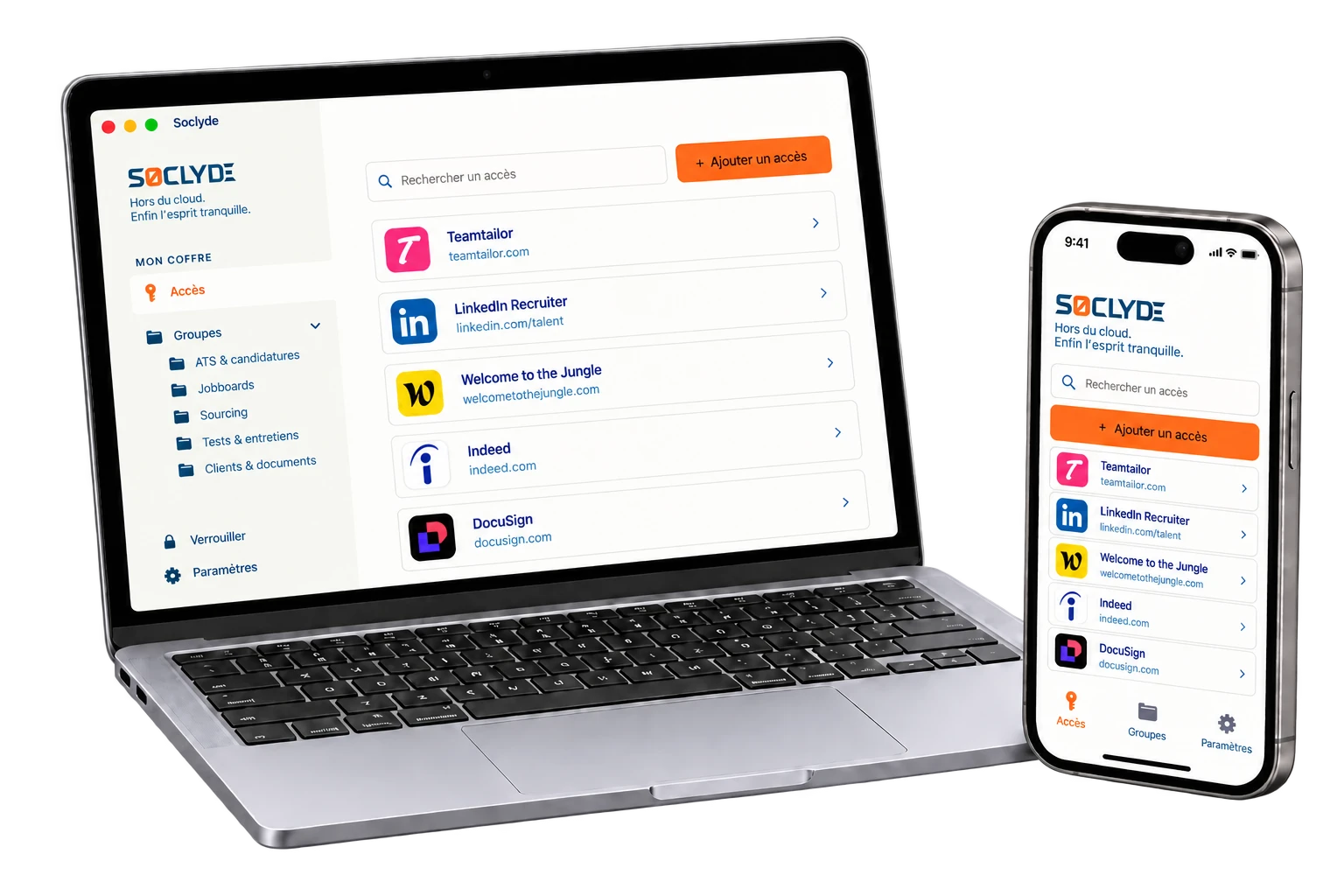




100% LOCAL0% CLOUD
Keep HR tools available without turning passwords into informal shared knowledge
Recruitment consultants, sourcers, HR managers, assistants and leadership do not all use the same tools. ATS platforms, CV databases, job boards, sourcing services, assessments and client portals must remain available according to assignments.
Soclyde organizes shareable secrets in a locally kept vault. Permissions can evolve with clients, assignments, consultants and providers.

Your HR tools on every device.
Soclyde works on Android, iOS, Windows and Mac. Find credentials at the office, on client premises or while working remotely.
Android
Native app
Mobile optimized
iOS
Native app
iPhone and iPad
Windows
Desktop app
System integration
Mac
Native app
macOS optimized
Centralizing recruitment access in a remote service adds another party to your chain of trust
With a cloud manager, the firm’s credentials also depend on external infrastructure: the vault is no longer kept only in your environment.
Services such as 1Password, LastPass and Dashlane synchronize passwords through their servers. This model can suit many organizations, but it adds a provider to the storage of accounts that open CV databases, sourcing tools and client portals.
A service holding many professional vaults also concentrates access with significant operational value.
Cloud model (hosted)!
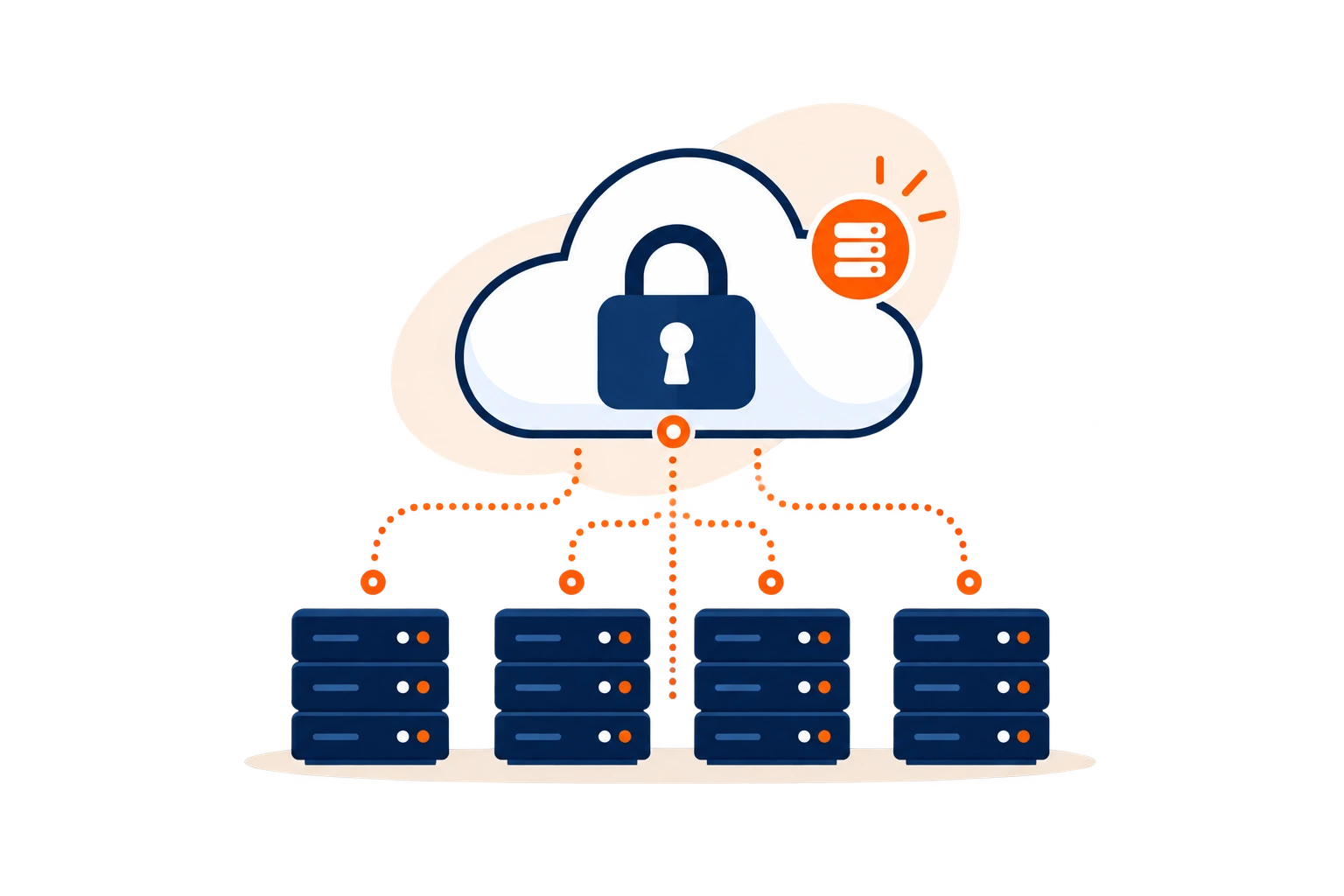
- The vault is kept on infrastructure outside the firm.
- A provider incident can affect many users at once.
- Hosting adds another party to the security policy.
Concentration effectA platform holding many professional vaults also concentrates high-value operational access.
Soclyde model (local)✓
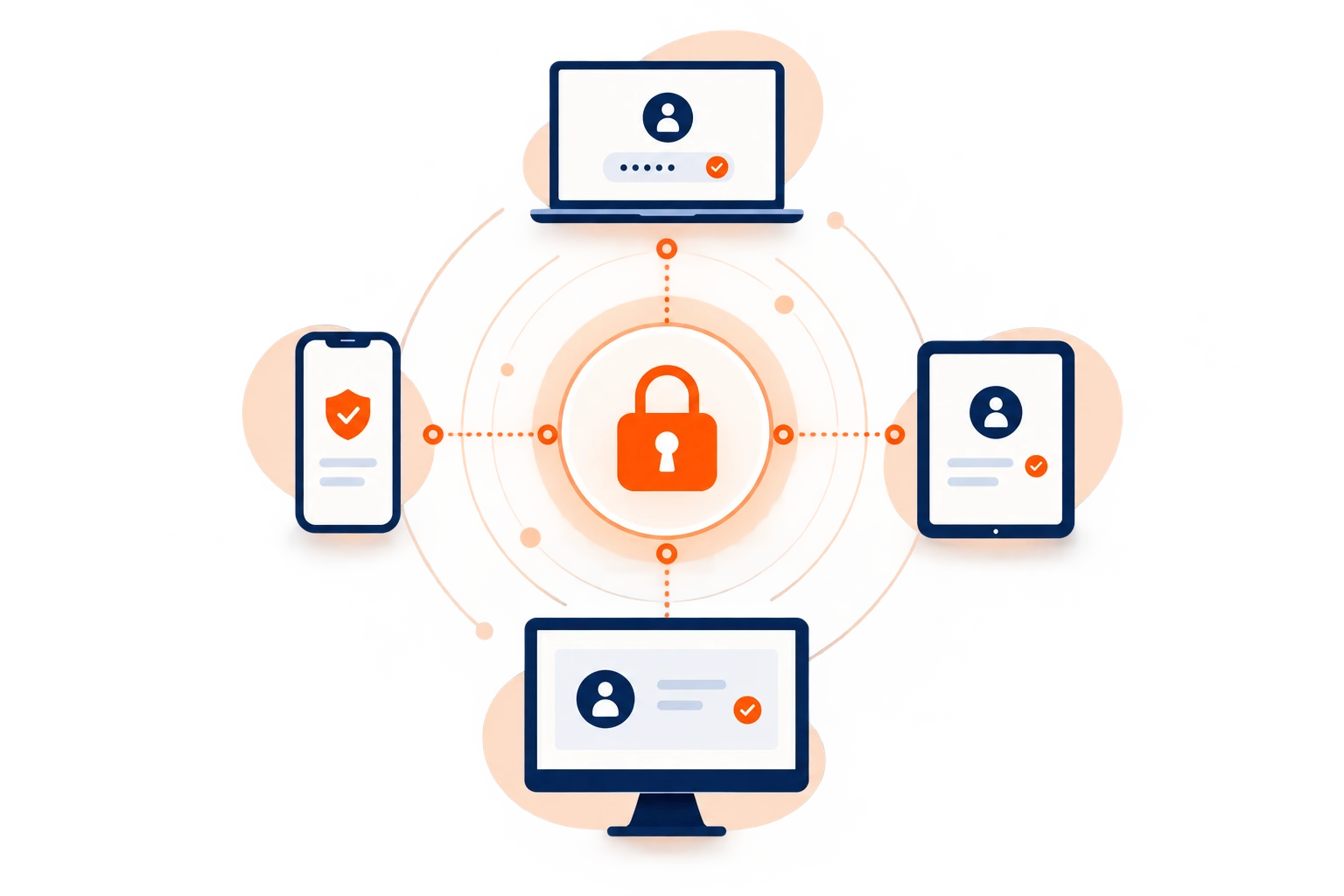
- Passwords stay on authorized firm devices.
- Soclyde does not host a global database of user vaults.
- The team retains direct control over credential storage.
Your recruitment vault stays in your environment.
ATS, sourcing and client access stays in the firm’s environment instead of a remote vault managed by Soclyde.
No global cloud vault
Less reliance on a host
Business access kept locally
Direct control of storage
Every new client brings more tools and stakeholders
Every new client adds tools, access and stakeholders: dispersion quickly becomes the real risk
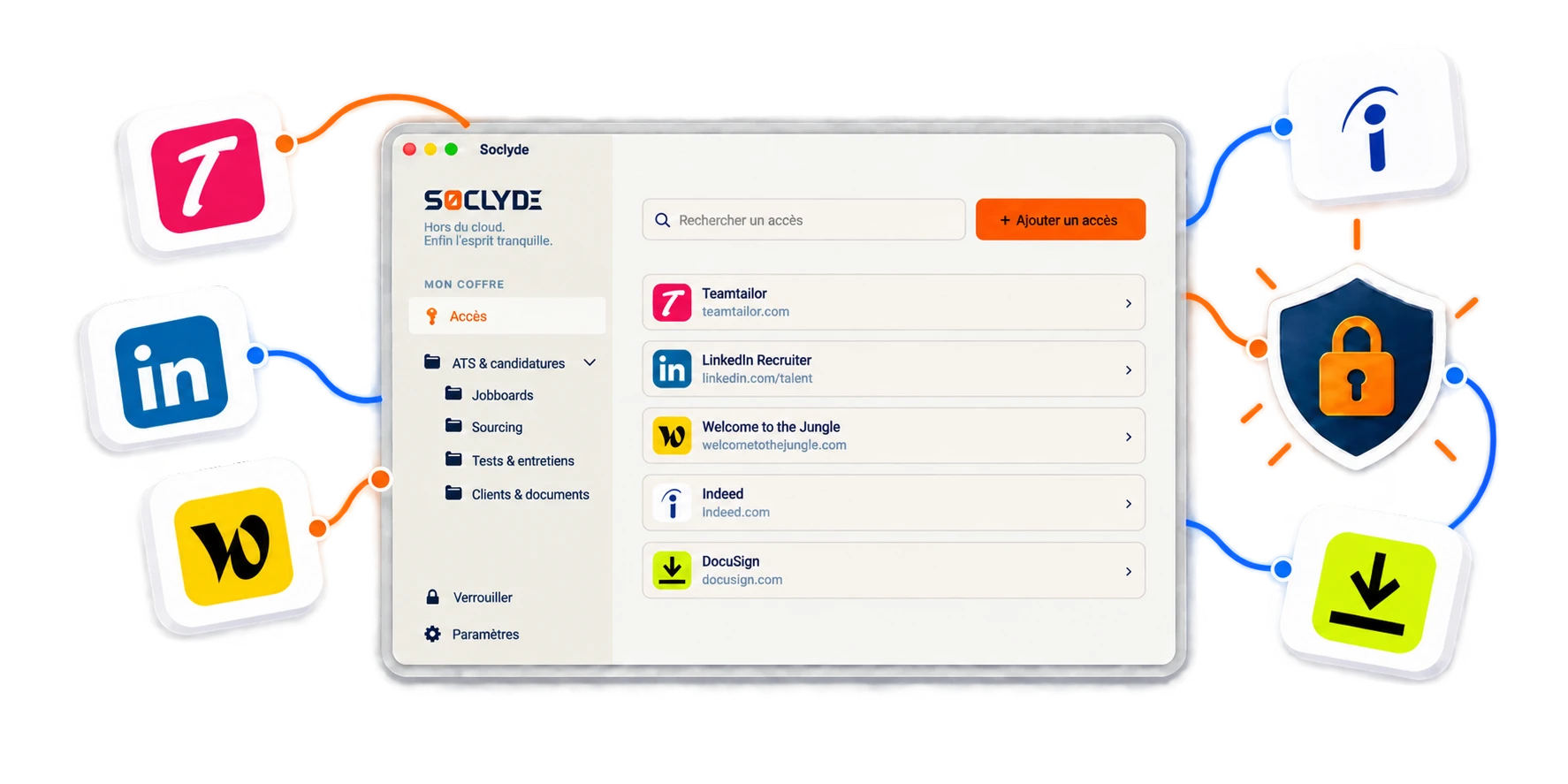
ATS platforms, job boards, LinkedIn Recruiter, CV databases, assessments, video calls, signing tools and client portals multiply as assignments grow. Without a shared reference, the firm can lose track of who has which access and where the latest password is stored.
A consultant takes over a recruitment assignment, a sourcer works across several clients, a freelancer joins for a few weeks or a new provider is added: needs change quickly. Over time, credentials can end up following people instead of assignments.
An assignment changes consultant
The right access does not always follow.
A shared subscription remains known
The secret may circulate after the need ends.
An external recruiter steps in
Access should be limited to the assignment and its duration.
A compromised account can expose more than a password
Compromised access can expose CVs, applications and confidential information
An ATS or CV database account can open profiles, contact details, assessments and confidential exchanges.
Risk grows when access is scattered across consultants, clients, devices and providers.
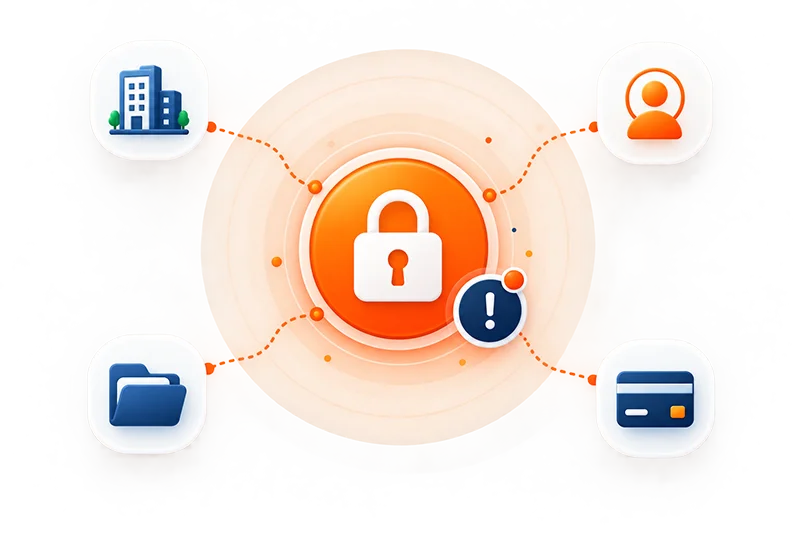
Candidate data in everyday work
Risk grows when access is scattered across recruiters, clients, devices and providers.
Mobility, parallel assignments and external support create moments that need clear access management. Four common situations deserve particular attention.
Candidate confidentiality also depends on ongoing control of the accounts used to access recruitment tools.
Sensitive candidate information
CVs, contact details, interview notes and assessments may be held across several recruitment tools.
Many recruitment platforms
ATS platforms, job boards, CV databases and sourcing tools each add accounts and credentials.
Work across locations
The office, remote work and client meetings create different contexts for accessing recruitment tools.
Changing assignments and teams
New clients, temporary support and departures make it important to review access regularly.
What should an HR or recruitment firm protect?
From sourcing to hiring, every step relies on different accounts
Access management should cover the whole recruitment journey without confusing named accounts and genuinely shareable secrets.
ATS and recruitment software
They centralize assignments, applicants, exchanges and tracking.
Job boards, CV databases and sourcing
These services open talent pools, adverts and subscriptions.
Assessments, video calls and references
These tools may hold evaluations and personal information.
Client portals, signing and collaboration
Permissions should follow the consultants responsible for each assignment.
When a recruiter or consultant leaves
A recruiter’s departure should not leave candidate or client accounts without an owner
A shared method identifies affected accounts, removes permissions and transfers the access still needed.
A recruiter may know access to ATS platforms, job boards, CV databases, assessment tools and client spaces. Closing their mailbox is not always enough.
When secrets stay in browsers or conversations, revocation becomes hard to verify.
Access to review before the last day
- List the tools used
- Remove obsolete permissions
- Reassign required access
- Change genuinely shared secrets when needed
The goal is to make access follow assignments and responsibilities: reassign the accounts still needed and methodically remove permissions that are no longer required.
Use case
Manage ATS and job board logins at your recruitment firm
Before an interview, you open the ATS to prepare the candidate file and the job board to review the listing.
The situation
Recruiters hand work between one another, and logins in notes or messages get lost and duplicated.
Find the credential
Bring ATS and job board credentials together in the Soclyde vault and find the right login when you need it.
Sign in to the service
With Premium sharing, colleagues can find shared logins in Soclyde without circulating extra copies of the password.

Your passwords stay encrypted in a vault on your devices, without a centralized Soclyde cloud vault. Keep business logins available and better organized day to day.
Choose for the pace of your firm
The best vault follows assignments, consultants and team changes
Soclyde combines local storage, device synchronization and team sharing without imposing a central server.
The right choice depends on consultants, tools, devices and the desired level of vault control.
| Criterion | KeePass | Bitwarden / LastPass / 1Password |  |
|---|---|---|---|
| Vault kept outside the cloud | ✓ Yes | × No | ✓ Yes |
| Synchronization across devices | ▲ Requires setup | ✓ Yes | ✓ Automatic |
| No server to maintain | ▲ Depends on setup | ✓ Yes | ✓ Yes |
| Control over storage location | ✓ Local | ▲ With the provider | ✓ Local |
| Offline access | ✓ Yes | ▲ Depends on the service | ✓ Yes |
| Usable without a dedicated IT team | ▲ Requires organization | ✓ Yes | ✓ Yes |
Cloud services simplify collaboration, but host the vault elsewhere
Cloud password managers make synchronization and sharing straightforward, which can suit distributed HR teams. In return, the firm’s credentials also depend on infrastructure operated by a third party. The vault is no longer kept only within the firm’s environment. This model may be appropriate; the decision is whether the firm wants to outsource vault hosting or keep the database directly on its devices.
A local file keeps storage under your control, but takes team discipline
KeePass stores its database in a local file, giving the firm direct control over where it is kept. When several consultants use several devices, synchronization, backups and file versions need to be managed carefully.
The 4 Soclyde principles
Four ways to secure recruitment without slowing sourcing
Useful access organization should remain simple for consultants while giving the firm a clear overview.
Organize by assignment
Credentials can be grouped by client, recruitment assignment and the tools used by the firm.
Each consultant can find the relevant secrets without searching through a general password list.
Keep the vault local
Access stays on the firm’s authorized devices, without a remote password database hosted by Soclyde.
The firm retains direct control over where its professional credentials are stored.
Sync without a central server
Changes are synchronized across authorized devices without a central password infrastructure to maintain.
The team avoids manual file copies and version conflicts.
Adapt permissions as teams change
Permissions can evolve with the consultants, clients and assignments each person handles.
A recruiter who leaves an assignment does not need to retain access that is no longer required.
Everyday use cases
New client, new consultant, new sourcing project: access must keep up
The value of a vault becomes clear during the transitions that shape recruitment work.
Starting a new assignment
Access to sourcing, the ATS and client tools can be organized from the outset.
The firm has a clear reference before credentials start circulating.
Taking over a recruitment assignment
The incoming consultant can find the tools they need without asking several colleagues.
Continuity depends less on a password saved in someone else’s browser or messages.
Bringing in an external sourcer
Access can be limited to the scope of the assignment rather than the whole firm vault.
Permissions that are no longer needed can be removed when the work ends.
Remote work and client visits
Previously synchronized credentials remain available on authorized devices.
Recruiters can use locally available access without relying on a remote vault.
A consultant leaves
Access needed for active assignments remains available to the people taking them over.
The firm can remove permissions that are no longer needed without starting from scratch.
Growing the firm
Each new consultant, client and tool adds credentials. Soclyde helps maintain a shared approach.
Access can grow without becoming a hard-to-review pile of files and messages.
CVs, interview notes and assessments
CVs, interview notes and assessments: access keys are part of the security perimeter
Recruitment firms process detailed personal information. Credentials opening these tools deserve the same rigor.
Local storage does not create compliance by itself, but it reduces the intermediaries involved in hosting the vault.
What local storage helps you control
- Vault not hosted by Soclyde
- Clearer separation of access by assignment
- Fewer secrets sent through messaging apps
- Easier-to-review permissions as teams change
The GDPR does not prohibit cloud services, and no password manager guarantees compliance on its own.
Use named accounts, roles and multi-factor authentication offered by ATS platforms and job boards whenever available.
Soclyde complements these controls for credentials that genuinely need to be stored or shared.
Compare solutions for an HR team
Choose for your organization: local file, cloud or local-first synchronization
SoclydeVSKeePass
What to know about KeePass
KeePass stores its database in a local file, giving the firm direct control over where it is kept.
With several consultants and devices, synchronization, backups and file versions need careful coordination.
The Soclyde approach
Soclyde keeps local storage while adding an approach designed for teams.
Authorized devices synchronize without the team having to handle a shared file.
SoclydeVSBitwarden
What to know about Bitwarden
Bitwarden offers team collaboration through its cloud service or a self-hosted deployment.
Self-hosting requires a server, updates, backups and ongoing monitoring.
The Soclyde approach
Soclyde avoids that infrastructure while keeping the vault local.
Synchronization works without a central server to maintain.
SoclydeVSLastPass
What to know about LastPass
LastPass uses a cloud architecture designed to make multi-device use straightforward.
The vault is hosted on external infrastructure.
The Soclyde approach
Soclyde does not gather user vaults in a global database.
Credentials remain on the firm’s authorized devices.
SoclydeVS1Password
What to know about 1Password
1Password offers extensive collaboration features around a cloud-hosted vault.
This model suits many organizations, while hosting the vault outside their own environment.
The Soclyde approach
Soclyde is designed for HR teams that want to collaborate without outsourcing vault hosting.
Permissions, sharing and synchronization are organized around authorized devices.
HR and recruitment FAQ
Questions HR and recruitment teams ask before organizing password access
Which password manager should a recruitment firm choose?
Look for support for multiple users and devices, assignment-based permissions and clear access management. Soclyde adds a local vault that is not hosted in the vendor’s cloud.
How should an HR firm organize passwords?
Group access by tool, client or assignment, limit it to the people concerned and document who takes over when a consultant’s responsibilities change.
How can ATS access be protected?
Use individual accounts and multi-factor authentication where available, limit roles and avoid sending shared credentials by email or chat.
Where should job board and CV database credentials be stored?
Avoid unprotected notes, spreadsheets and conversations. A dedicated password manager can centralize shareable credentials and help control who can use them.
How can we avoid sending passwords by email or Teams?
When sharing is appropriate, grant access through a team vault instead of pasting the secret into a conversation. This limits how widely the password circulates.
What should we do when a consultant leaves the firm?
List the accounts they used, remove permissions that are no longer needed, change genuinely shared passwords where necessary and reassign access for ongoing assignments.
Can a password manager without cloud hosting work for a remote HR team?
Yes, if authorized devices can synchronize as designed. Devices, backups and authentication methods also need appropriate protection.
How can a password manager help protect candidate data?
It protects the credentials used to access tools containing candidate data. It should be complemented by individual accounts, strong authentication, limited permissions and an appropriate retention policy.
How should LinkedIn Recruiter or CV database access be managed?
Prefer the named accounts and roles offered by the platform. When a password genuinely needs to be shared, keep it in a team vault rather than a browser or message.
Is KeePass suitable for a recruitment firm?
KeePass can work for local storage, but a team then needs to organize synchronization, backups and file sharing across devices.
Are passwords saved in Chrome or Edge enough?
They can help individuals, but a firm also needs a shared view of access, orderly handovers and a clear process for removing access when people leave.
How should access for a freelance or RPO recruiter be managed?
Grant only the access needed for the assignment and remove it when it is no longer required. Avoid sharing more credentials than the agreed scope needs.
Does Soclyde require a server at the firm?
No. Soclyde is designed to synchronize authorized devices without installing or maintaining a central password server.
Where are passwords stored with Soclyde?
Soclyde does not host the vault. It remains on authorized devices, unlike a traditional cloud password manager.
Does Soclyde guarantee GDPR compliance for an HR firm?
No. No password manager guarantees compliance on its own. The firm must also manage its processing, data retention, processors, access rights, authentication and device security.
Candidates change. Assignments change. Your access must stay organized.
Group ATS, CV database, job board, sourcing, assessment and client access in a local vault designed for assignments and team changes.
- Organization by client and assignment
- Local vault on authorized devices
- Synchronization across workstations
- Clearer permissions during team changes
Soclyde keeps passwords on authorized devices, synchronizes them simply and manages permissions without a central server.