Password manager for notaries and judicial commissioners: keep your firm’s credentials under your control
A notarial office or judicial commissioner’s practice uses CRMs, legal practice portals, filing platforms, banking spaces, aggregation tools, signing solutions and legal practice portals every day.
Soclyde helps notaries, judicial commissioners and independent legal practices organize legal practice credentials in a local vault that can be used by a team. Passwords stay on authorized devices, without a remote vault hosted by Soclyde.
- Off-cloud vaultAccess stays on your devices
- Team synchronizationNo centralized password server
- Case-based accessNotaries, clerks and support teams
- No dedicated infrastructureNo vault server to administer
- Controlled permissionsWhen roles or cases change
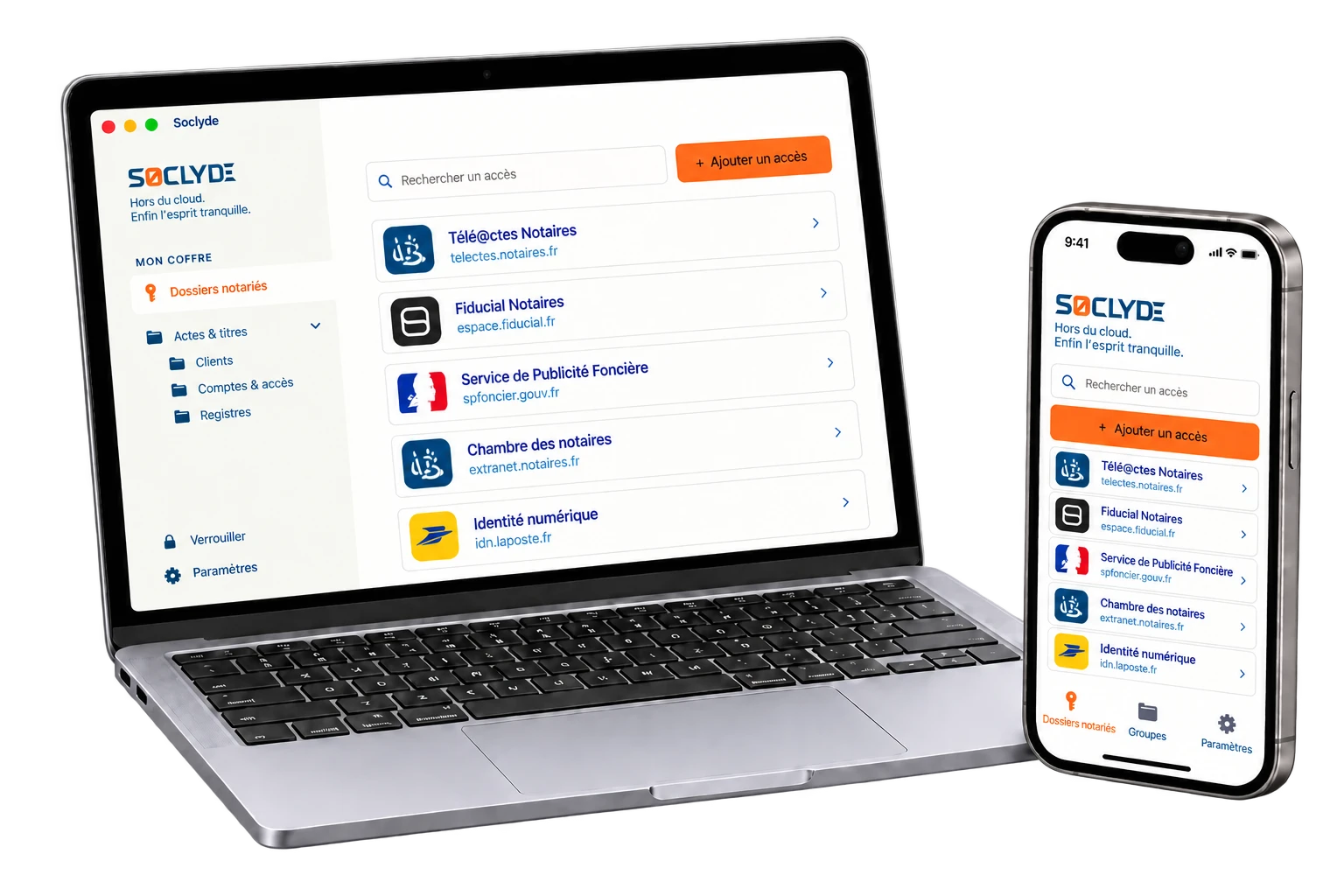




100% LOCAL0% CLOUD
Keep professional cases accessible without exposing every access to the whole team
Notaries, judicial commissioners, clerks, assistants and practice managers do not always use the same services. CRMs, legal practice portals, filing platforms, document spaces and e-signature tools must remain accessible according to cases and assignments.
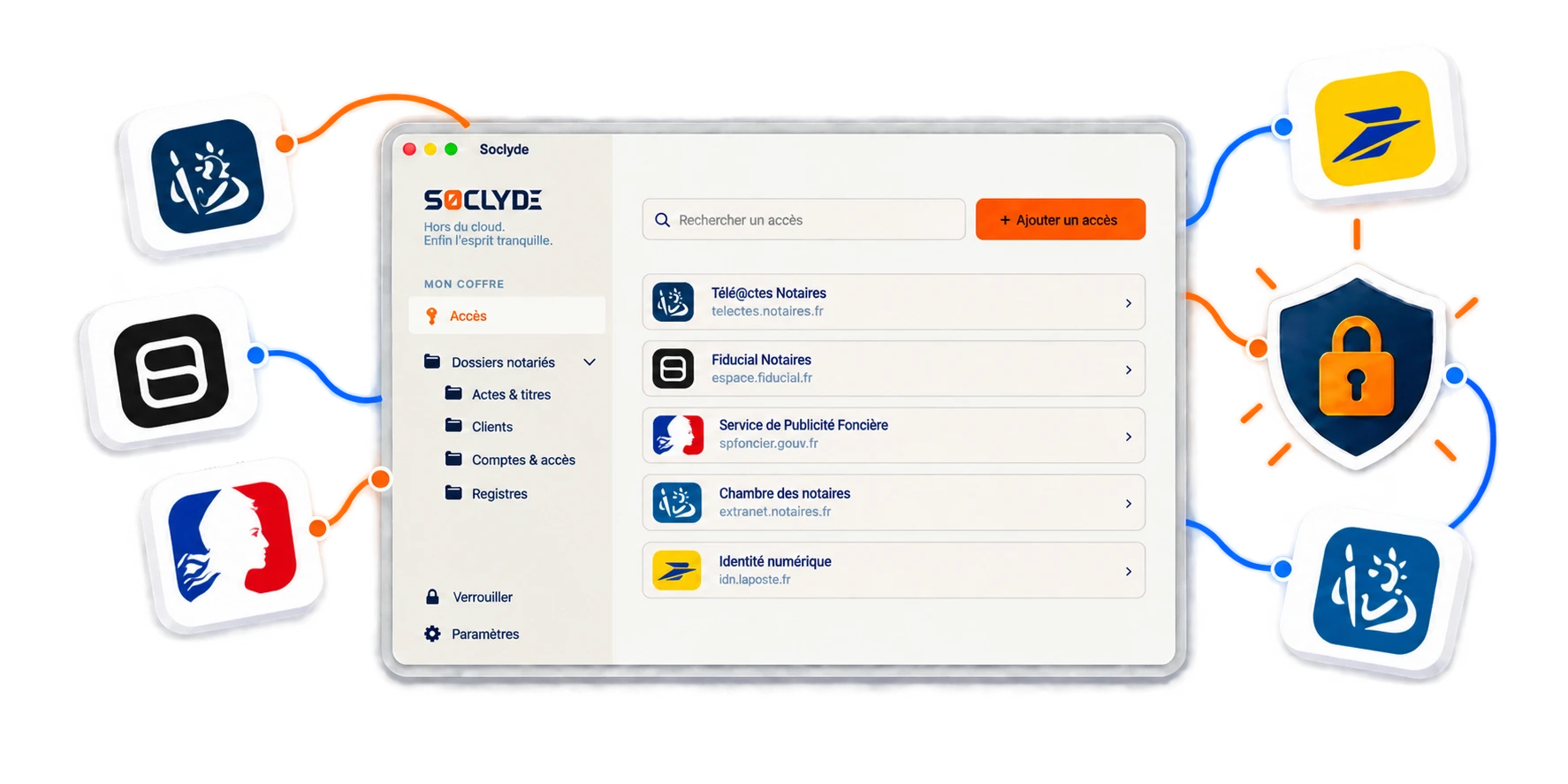
Soclyde organizes shareable secrets in a locally kept vault. Permissions can evolve with cases, professional services, arrivals and departures, while everyone finds only the access needed for their work.

Your firm’s credentials on every device.
Soclyde works on Android, iOS, Windows and Mac. Find your credentials at the practice, with a client or on the move.
Android
Native app
Mobile optimized
iOS
Native app
iPhone and iPad
Windows
Desktop app
System integration
Mac
Native app
macOS optimized
Your credentials open cases, contracts and sensitive data: storage can remain in your environment
With a cloud manager, the practice’s credentials also rely on an external infrastructure. Soclyde keeps the vault on authorized devices and synchronizes the team without a global cloud database.
With a cloud manager, the practice’s credentials also rely on external infrastructure: the vault is no longer kept only in your environment.
Services such as 1Password, LastPass or Dashlane synchronize passwords through their own servers. This model may suit many organizations, but a legal practice adds access to legal practice portals, filing platforms, client spaces and legal practice tools.
A vault gathering many notarial and judicial commissioner credentials concentrates accounts with high legal and operational value.
Cloud model (hosted)!
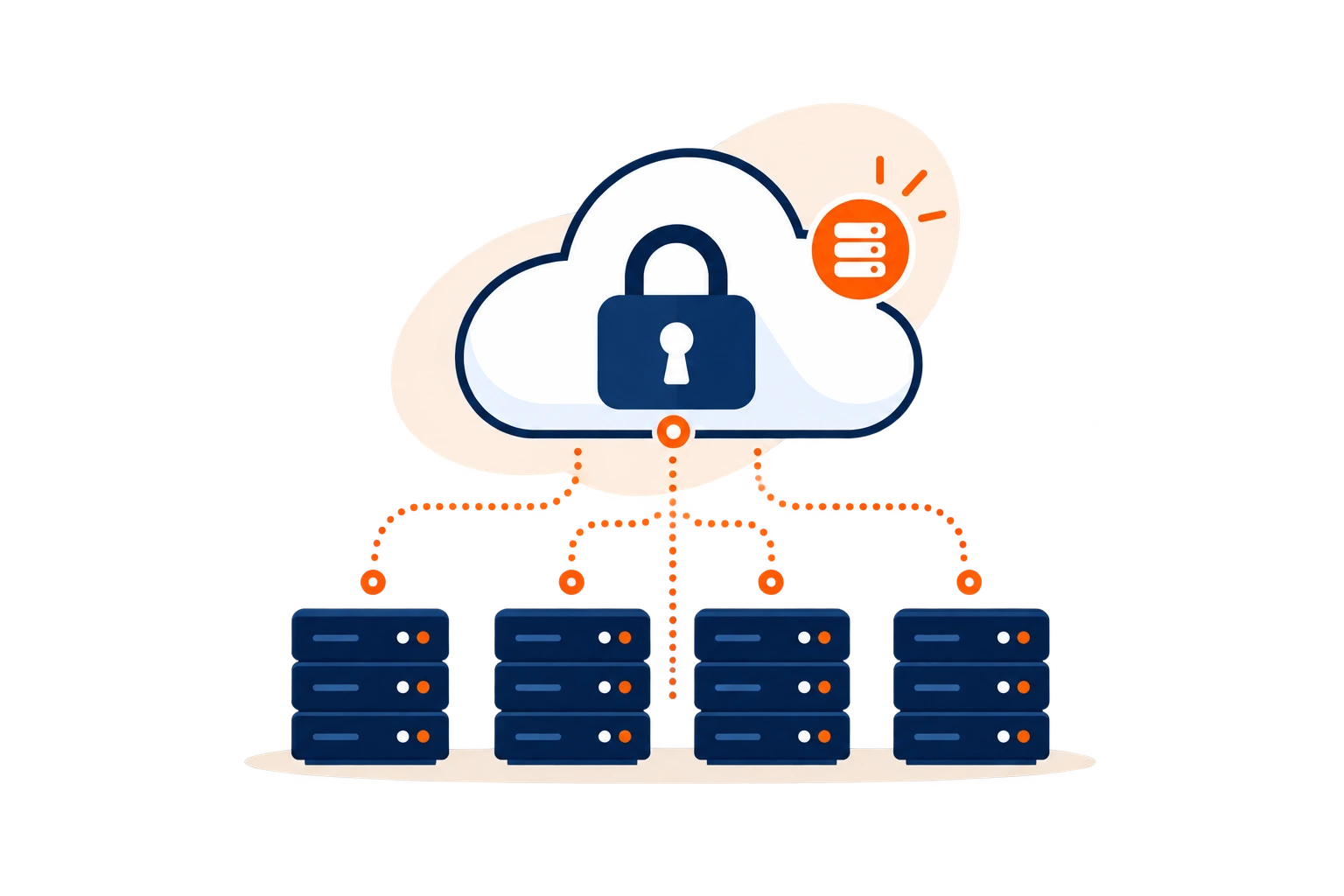
- The vault is kept on infrastructure outside the practice.
- A provider incident can affect several sensitive accounts at once.
- Hosting adds another party to the practice’s chain of trust.
Concentration of sensitive accessLegal practice portals, filing platforms, CRMs and document spaces gathered in one vault represent a high-value target.
Soclyde model (local)✓
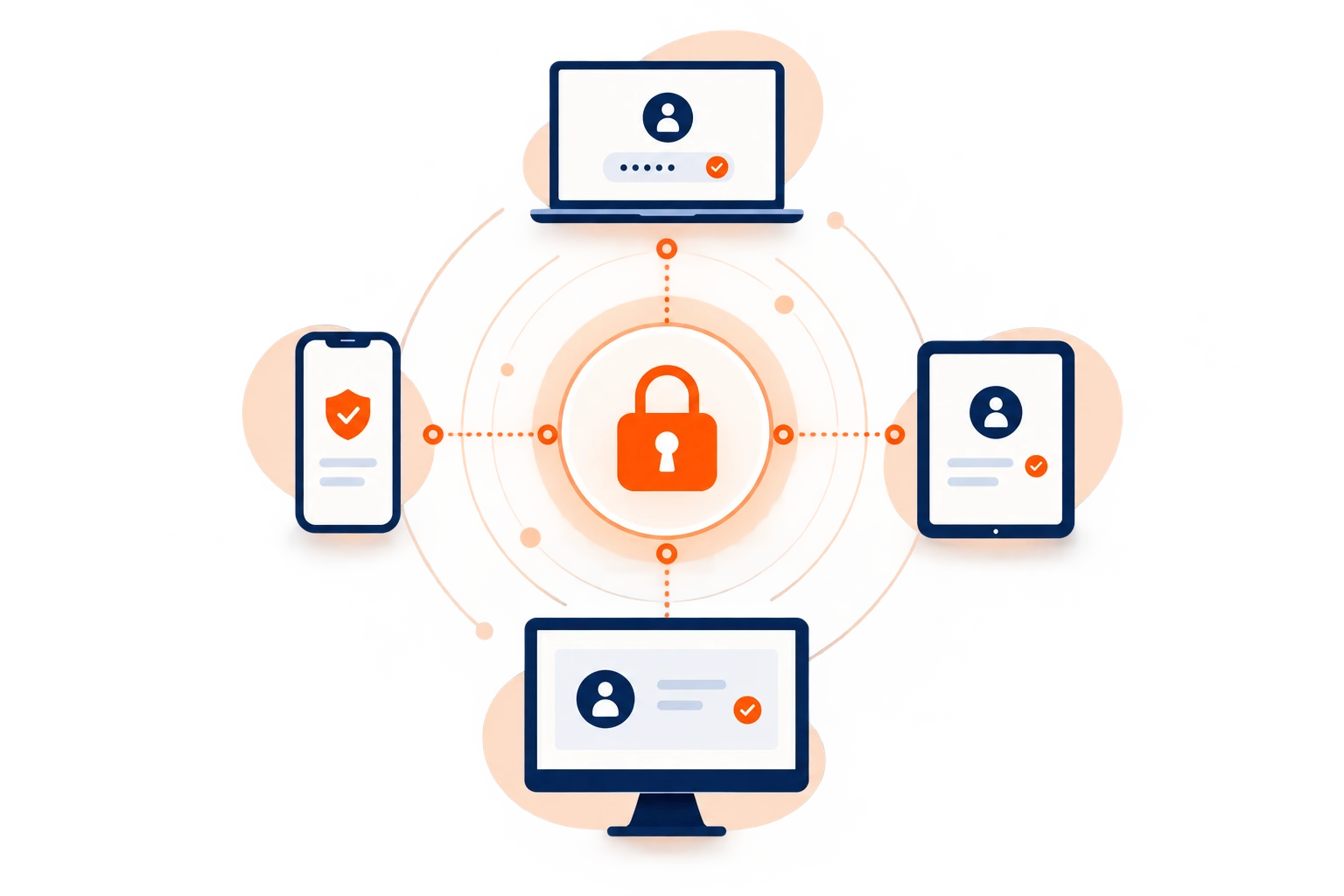
- Passwords stay on the practice’s authorized devices.
- Soclyde does not host a global database containing its users’ vaults.
- The practice keeps direct control over where its credentials are stored.
Your practice vault stays in your environment.
Your practice vault stays in your environment. Access to legal practice portals, filing platforms and business tools does not have to be deposited in a remote database managed by Soclyde.
No global cloud vault
Less reliance on a host
Business access kept locally
Direct control of storage
When every business service has its own portal
Practice software, filing platforms and client records: access grows faster than cases
CRMs, legal practice portals, filing platforms, document spaces and signing tools multiply across professional services. Without a shared reference, practices lose track of who has which access and where the latest password is stored.
A notary or judicial commissioner takes over a case, an assistant prepares a filing, a colleague covers an absence or a new business service is added: needs change quickly. Over time, credentials follow people rather than cases.
A case changes hands
Partner access does not always follow the new owner.
A shared portal remains known
Access can remain in use after the need has ended.
A critical access depends on one person
An absence or departure can block an urgent operation.
A compromised access can expose more than a password
Portals, filings and client data: some keys unlock highly sensitive information
A professional service account can expose personal information, legal documents, case history and procedural details, as well as filing or document-management functions.
For a legal practice, protecting credentials also protects file confidentiality, service continuity and client trust.

Sensitive firm credentials
Risk grows when credentials are spread across notaries and judicial commissioners, assistants and professional services.
Mobility and case changes create sensitive moments. Four common situations require a clear system.
Professional confidentiality also depends on continuous control over the accounts that provide access to business tools.
Highly sensitive client data
Client identity, legal documents, case history and procedural information may appear in several business tools.
Many professional services
Filing platforms, document portals and specialized professional services multiply portals and credentials.
Frequent mobile usage
Client meetings, travel and remote work require access to the right credentials across devices.
Regular team changes
Arrivals, departures and case handovers make permissions difficult to maintain without a shared reference.
The practice’s business access
Every business service adds another entry point: keep one system for managing them all
A notarial office or judicial commissioner’s practice relies on an ecosystem of professional services and platforms. The challenge is not only storing passwords, but distinguishing named access, genuinely shareable secrets and critical accounts.
CRM and client tracking tools
A CRM often centralizes personal information, meeting history, documents, tasks and data related to legal matters.
Named accounts and roles should be preferred. Genuinely shared secrets should remain limited to the people concerned.
Legal practice portals and filing platforms
These portals may provide access to contracts, simulations, filings, supporting documents and client information.
Individual access and MFA should be used when available. The vault complements these mechanisms for secrets that genuinely need to be kept.
Filing platforms, document portals and professional services
Each business service may have its own portal, access rules and recovery methods.
A shared reference helps prevent credentials from remaining scattered across browsers, emails or personal notes.
Signing, document management and collaboration tools
These services support the preparation, transmission and archiving of advice-related documents.
They should follow the same access-management policy as professional filing platforms.
When a notary or judicial commissioner leaves the practice
A departure should transfer cases without leaving old access behind
A shared system helps identify affected access, remove permissions that are no longer needed and pass on what the new owner requires.
A notary or judicial commissioner may know access to the CRM, legal practice portals, filing platforms, banks, aggregators, signing tools or document spaces. Closing their mailbox is not always enough.
When passwords are saved in a browser or sent through messaging, revocation becomes difficult to verify. A shared system makes it clear what must be removed, changed or transferred.
Access to review when a case changes hands
- List the accounts used
- Remove unnecessary permissions
- Reassign the access still needed
- Review shared accounts and recovery methods
The goal is to make access follow cases while unnecessary permissions are removed methodically.
Use case
Find case access before a meeting at the practice
Between filings, you check a professional portal and review a case before meeting your client.
The situation
Access to the practice’s tools should not depend on a personal note or the colleague who set them up.
Find the credential
Find the portal credentials in the Soclyde vault alongside the practice’s other business logins.
Sign in to the service
Open the service and continue preparing the case. With Premium sharing, colleagues can find a shared credential in Soclyde instead of sending the password around.

Your passwords stay encrypted in a vault on your devices, without a centralized Soclyde cloud vault. Keep business logins available and better organized day to day.
Choose for your legal practice
The right manager should follow your cases without adding infrastructure to your practice
Soclyde combines local storage, device synchronization and team sharing without requiring a central server to operate.
For a legal practice, the choice depends on the number of notaries and judicial commissioners, professional services, devices and the desired level of control over the vault. Cloud, local and self-hosted solutions answer these needs differently.
| Criterion | KeePass | Bitwarden / LastPass / 1Password |  |
|---|---|---|---|
| Vault stays on your devices | ✓ Yes | × No | ✓ Yes |
| Synchronization between devices | ▲ To organize | ✓ Yes | ✓ Automatic |
| No server to administer | ▲ Depends on organization | ✓ Yes | ✓ Yes |
| Control over storage location | ✓ Local | × With provider | ✓ Local |
| Offline access | ✓ Yes | ▲ Depends on service | ✓ Yes |
| Use without dedicated IT team | ▲ Requires organization | ✓ Yes | ✓ Yes |
Cloud makes collaboration easier, but hosts credentials outside your environment
Cloud managers offer smooth synchronization and fast sharing, which can suit distributed teams. In return, access to portals, filing platforms and other legal practice tools also relies on third-party infrastructure. The key question is whether the practice wants to outsource the vault or keep its secrets directly on its devices.
A local file keeps control, but can be difficult to share between notaries and judicial commissioners
Tools such as KeePass keep the database local and provide direct control over the credential file. With several notaries, judicial commissioners and devices, synchronization, backups, version conflicts and permissions still need to be organized. Without a shared method, access can end up spread across files, browsers and internal notes.
The 4 Soclyde principles
A well-organized vault should disappear into the background while notaries and judicial commissioners focus on client matters
Soclyde starts from a simple principle: a notary or judicial commissioner should find the right access for a case without opening every secret in the practice. Security must remain compatible with meetings, filings, follow-up and organizational changes.
Organize by case
Credentials can be structured around professional services, client matters and the tools they use.
Each team member finds the required secrets without browsing the entire vault.
Keep the vault on your devices
Access stays on the practice’s authorized devices, without a remote database hosted by Soclyde.
The practice keeps direct control over where its secrets are stored.
Synchronize without a central server
Changes follow authorized devices without vault infrastructure to install and maintain.
Teams avoid manual file copies and version conflicts.
Evolve permissions with team changes
Permissions can follow cases, arrivals, departures and delegations.
A colleague does not have to keep access to a case they no longer manage.
When cases evolve
New client, new filing, new colleague: access should follow the work
The value of a password manager appears during transitions: client onboarding, filings, departures, case handovers, external meetings and business service changes.
New client onboarding
Access to the required tools can be organized from the start of the relationship.
The practice avoids letting secrets begin their life in an email or personal note.
New filing
Legal practice portals, signing, document management and other services can be grouped around the relevant case.
The team finds the required access at the right time.
Case handover
The new notary or judicial commissioner can receive the required access without relying on the predecessor’s browser.
The handover becomes clearer and old permissions can be reviewed.
Client meeting
Already synchronized credentials remain available on authorized devices.
The notary or judicial commissioner does not need to ask the practice for a password during a meeting or follow-up.
Colleague departure
Permissions can be reviewed alongside cases and responsibilities.
Genuinely shared secrets can be changed when necessary.
New business service
Every new portal or platform adds accounts. Soclyde helps keep one shared system.
The practice can expand its offering without turning access into a collection of files and messages.
Legal and client data, confidentiality and compliance
Client identity, legal documents and case information: access keys are part of the security perimeter
A legal practice processes personal, legal and client information that can be highly detailed. Credentials providing access to CRMs, documents, contracts and business service platforms must therefore be managed with the same rigor.
Protection is not only about storage: the practice must know who holds access, where the secret is kept, how it is transmitted and when the right should be removed.
A local architecture does not automatically make a practice compliant with GDPR, professional obligations or business service requirements. It can reduce the intermediaries involved in storing the vault and make credential organization clearer.
What local storage helps you control
- Vault not hosted by Soclyde
- Clearer separation of access by case
- Fewer secrets sent by email or messaging
- Clearer permission management when teams change
GDPR does not prohibit cloud services, and compliance is not reduced to password storage. The practice must also manage permissions, processing, providers, retention and other security measures.
CRMs, banks, professionals and business service platforms often offer named accounts, roles and MFA. Those mechanisms should be preferred when available. Soclyde complements them for secrets that genuinely need to be stored or shared.
The value of the local model is precise: it does not add a password-vault hosting service to the technical chain. The practice keeps an architecture that is easier to understand and supervise.
Compare solutions for a legal practice
Cloud, local file or local-first: the vault architecture changes case management
SoclydeVSKeePass
What to know about KeePass
KeePass keeps the database in a local file and provides direct control over its location. With several notaries, judicial commissioners and devices, synchronization, backups and version management become more complex.
The Soclyde approach
Soclyde keeps local storage while adding a team-oriented workflow. Authorized devices synchronize without manually handling a shared file, and access can follow cases without a central server.
SoclydeVSBitwarden
What to know about Bitwarden
Bitwarden offers collaboration through its cloud or a self-hosted deployment. Self-hosting adds control but requires a server, updates, backups and supervision.
The Soclyde approach
Soclyde avoids that administration layer while keeping the vault local. Authorized devices synchronize without a central password server to operate.
SoclydeVSLastPass
What to know about LastPass
LastPass relies on a cloud architecture designed for multi-device use. CRM, portal and other sensitive access also rely on external infrastructure.
The Soclyde approach
Soclyde does not gather its users’ vaults in a global database. Credentials stay on authorized practice devices while synchronization remains available.
SoclydeVS1Password
What to know about 1Password
1Password offers a premium collaborative experience around a cloud vault. This model suits many teams but externalizes the vault.
The Soclyde approach
Soclyde targets practices that want collaboration without outsourcing their vault. Rights, sharing and synchronization are organized around authorized devices.
Legal practice FAQ
Questions notarial and judicial practices ask before centralizing passwords
Are passwords hosted by Soclyde?
No. The vault stays on authorized devices rather than in a centralized cloud vault operated by Soclyde.
Can Soclyde work offline?
Vault data remains available locally on authorized devices, each of which keeps a complete copy of the vault.
Can notaries, judicial commissioners and assistants share access?
Yes. Sharing access between users is part of Soclyde Premium. Roles and the revocation process should be defined around the office’s organization.
Does Soclyde guarantee GDPR compliance?
No. The practice must also manage its processing, permissions, devices, backups and providers.
Which manager should a legal practice choose?
Choose a solution that handles multiple users, devices, cases and permission levels while considering where the vault is stored.
How should a legal practice organize access?
Classify secrets by business service, tool, case and criticality: CRM, portals, filing platforms, banks, signing and document management.
What should happen when a notary or judicial commissioner leaves?
List the tools used, remove unnecessary permissions, reassign access and review recovery methods for critical accounts.
Is KeePass suitable for a notarial office or judicial commissioner practice?
KeePass can work for local storage, but a team must organize synchronization, backups, file versions and permissions.
Are browser-saved passwords enough?
They can help individuals, but a practice also needs a shared view of permissions, clean handovers and a clear revocation process.
Can a professional service account be shared between notaries and judicial commissioners?
When a business service offers individual accounts or roles, those should be preferred. A manager should not bypass a rule requiring named access.
Does Soclyde require an administered server?
No. Soclyde is designed to synchronize authorized devices without a central password server to install or maintain.
Where are passwords hosted with Soclyde?
The vault is not hosted by Soclyde: it stays on authorized devices, unlike a traditional cloud password manager.
How should access follow a case handover?
Prepare an inventory of accounts, assign them to the notary or judicial commissioner taking over and review shared secrets and recovery methods.
How do you protect legal and client data with a password manager?
A password manager protects credentials, but it does not replace permissions management, device security, MFA, backups, procedures or compliance.
How do you organize access to filing platforms?
Prefer named accounts and MFA when available, then limit shared secrets to the people who genuinely need them.
Your clients’ cases evolve. Your access, however, should stay perfectly organized.
Group CRMs, legal practice portals, banks, filing platforms, documents, signing and document tools in a vault stored on your devices, designed for cases, notaries, judicial commissioners and team changes.
Between cloud managers that host the vault, local files that require manual organization and self-hosted solutions that add infrastructure to maintain, Soclyde takes a different approach: keep passwords on authorized devices, synchronize them simply and manage permissions without a central server.
- Access organized by case and business service
- Off-cloud vault on authorized devices
- Synchronization across practice workstations
- Clearer permission management when teams change
CRMs, portals, banks, filing platforms, aggregators and document tools shape a legal practice’s daily work. With Soclyde, shareable credentials stay organized in your environment without a global cloud vault.